Patrol Quiet
a speech by Dennis Sedgwick
Patrol Quiet a speech by Dennis Sedgwick
|
|
 |
|
"Dive! Dive!"
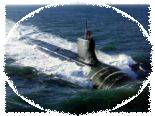
The Command is given twice, never once, never thrice, and followed by two blasts of the klaxon, the diving alarm. The diving officer flips the switches that vent the ballast tanks, and the submarine, the most mysterious of warships, slips silently beneath the sea. The young petty officer on his first patrol listens, wide-eyed with surprise and apprehension, to a sound he has not been prepared for, the snapping and creaking and popping of the pressure hull of the ship as it actually compresses under the pressure of the sea. Then even this sound stops; the ship has reached operating depth. Another command is passed, "Rig ship for patrol quiet." Another fleet ballistic missile submarine deterrent patrol has begun. For the next two months this ship and crew, 130 officers and men, will remain quiet and hidden in the deep, prepared to launch 16 nuclear missiles if necessary, so that any potential enemy who would think to launch a nuclear attack against the United States will be deterred by the knowledge that they and others like them are there. You have probably never been on a submarine, only a few of us have, but this evening the captain has extended to you an invitation to join us on this patrol. Learn how a submarine works; learn how its crew works; but hurry aboard - we're already underway. Come with me now to the control room of the ship. This is where we drive it. To aft you see the periscope stand with two periscopes. The larger one is for navigation; the other, leaner and meaner, is the attack scope. Both are lowered now because they are of no use unless we are close enough for them to reach above the surface. The "conning officer" is seated on a small stool which swings out from the wall or bulkhead. He is responsible for the ship's operations at this time. Even the captain does not give operational orders without first saying, "I have the conn." To forward you see the diving stand, which somewhat resembles the cockpit of a plane, though not as cramped and not as complicated. Two young seamen man the diving stand; one is the helmsman, one the planesman. Using the wheels on sticks in front of them they operate the rudder and the planes. The planes are the rudder-like devices that steer the ship up and down under water. Either or both can be controlled from either wheel and stick, but during the diving maneuver they are usually controlled separately. Both can also be switched to automatic control. You are impressed at the professional manner in which even these two young men attend to their duties. Professionalism seems to enhance "Patrol Quiet". You see to port the diving stand. The diving officer operates it. He explains how a submarine dives and surfaces: "A submarine floats the same way a glass does when it's turned upside-down, by trapping air. The submarine has two hulls, the inner pressure hull and the outer hull. Much of the space between the two hulls is partitioned into several "ballast tanks," which are open at the bottom. Air trapped in the ballast tanks displaces water, and the ship floats. When the command is given to dive, I use these switches to open vent valves at the tops of the tanks. This allows the air out of them, and water flows in the bottom to displace it, so then the ship displaces less water and submerges. Once we're down and the tanks are full of water, I can close the vent valves. When it's time to surface, I use these other switches to open valves that will allow compressed air from air tanks into the tops of the ballast tanks. This blows the water out the open bottoms, and the ship is pulled to the surface by the additional flotation. If the ship were ever to roll over, it would lose its air and sink, just like a glass." We shudder at the thought. We move aft to learn about the ship's power and propulsion systems. We pass through a tunnel through the reactor compartment. We know the reactor itself is just a few feet below us; we wonder about this. In the engine room control area the engineering officer teaches us: "Aboard this ship you are exposed to less radiation than you are while standing outside; the shielding is that good. We see that perhaps nuclear power solves more problems than it causes. Returning forward, we enter the missile compartment. We see the 16 missile tubes. We are told that the missile in each of them is capable of carrying more fire power than all the bombs dropped in World War II, including the atomic bombs at Nagasaki and Hiroshima. We are told that there are three main systems involved in the launching of a missile, navigation, fire control, and launch systems. The navigation computers measure the ship's velocities in the north-south, east-west and vertical axes, and keep track of ship's position. They send this data plus ship's attitude, which is heading, roll and pitch, to the fire control computers. The fire control computers have target positions stored in them, and based on target position and ship's position they calculate the trajectories to the targets. They feed to each missile its trajectory plus the velocity and attitude data continually until the missile has left the ship. The launch system is the electronically controlled mechanical system that ejects the missile from the ship. We learn that when a missile is launched it rises to the surface inside a bubble of gasses generated for the purpose, so that it never comes into contact with the water through which it passes. We are also told that there are several fail-safe points within the launch and fire control systems to ensure against accidental or unauthorized launching. We are glad to hear that. The missiles are the reason for the ship's existence, but in case the missiles were launched, the ship carries torpedoes and would serve a secondary mission as an attack vessel against enemy ships, the classic submarine function. We tour the torpedo room and then go to the mess area for the evening meal. The watch has been relieved and we see at this sitting the people we met on our tour. The ongoing watch ate at the first sitting. One third of the crew is on watch at all times. We are surprised at how well submariners are fed. Steaks and pork chops are not uncommon faire. Several weeks later we are pleasantly surprised when the cook breaks out trout for the crew, and enough for two for everyone. After the evening meal the movie of the day is shown. Sixty new movies were brought aboard before we left port, almost enough for one new one per day. We're allowed to show a second movie after the first, but we may not show a movie before its scheduled date. There is generally a low-stakes poker game going in the crew's lounge down by the berthing area. There is probably a bridge game or two, or a pinochle game. We see two men playing chess, two playing backgammon, and one reading a book. Another is working on a college correspondence course. Each Saturday there is a bingo game; tickets are sold and real prizes are given. The money goes into the pot to buy the prizes for the next patrol. If there is enough it will also pay for a beer bust. The weeks pass in this manner: on watch 1/3 of the time, sleeping about the same, some minor maintenance on the equipment of our specialty, but primarily movies, games, visiting and reading the remainder of the time. The most unusual thing that happens is a drill every once in a while. Sixty days is a long time, and a short time, too, but no one would wish it to be longer. Then one day missile readiness is ended. We go deep and run fast back towards port. We reflect on the things we have learned, and wait with anticipation for a command we want to here. "Surface! Surface! Surface!" The Command is given thrice, never once, never twice, and followed by three blasts of the klaxon, the diving alarm. The diving officer flips the switches that blow the ballast tanks, and the silence of patrol quiet is broken by the rush of air and water. The submarine is lifted to the surface, and with it the hearts of 130 officers and men. The remaining tasks are all part of getting home, and their thoughts turn there. Home, families, the sun, a thousand things to do. This patrol will soon be a memory. As we arrive at the dock, the captain speaks to the visitors, "We hope you have enjoyed this patrol. We bid you a good evening." |