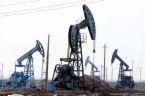
They're alive! They're alive!
The oil fields are alive!
They're alive with Energy and Industry and Technology,
and People and Machines and Equipment.
Hustle and Bustle prevail,
and Progress is the order of the day.
Roustabouts and Pumpers work the fields,
and Pipe fitters and Electricians,
and Technicians and Engineers of many disciplines.
Drilling Rigs and Pulling Rigs, Pumping Units,
Steam Generators and Sulfur Dioxide Scrubbers,
Free Water Knock Outs and Heater Treaters -
all these are among the equipment found in modern oil fields.
Is it any wonder that some would be fascinated by all this?
Good evening, toastmasters and guests,
it's a pleasure for me to be here. |
 |
Yes, the oilfields are alive, and it is fascinating.
I have compared my fascination with the oil fields
to Mark Twain's love of the Mississippi River.
It's based on the same type of awe at the activity.
I want to share some of the wonder of it with you this evening.
There aren't many oil fields in Michigan, where I grew up,
but we did drive by one small one
when we went to visit my great uncle.
Sometimes we would have a picnic lunch at a small roadside park
right there in sight of a few of the wells.
I would sit and watch the pumping units go up and down
the whole time we were there.
It made an impression on the mind of a young boy
that remains many years later.
I don't remember seeing any other oil wells until early in 1979
when I first saw the Kern River Field at Bakersfield.
I was amazed!
There are 6 or 7 thousand wells in that one field alone!
My business, electrical and electronic controls,
immediately put me face to face with the technology of a modern oil field,
and especially that of Secondary Recovery.
Let me explain that term to you,
along with its predecessor, Primary Recovery.
Primary Recovery can be thought of as "getting the easy stuff."
Some oil reservoirs are under pressure;
these are the ones that produce "gushers" when they are drilled.
For them the first stage of production is simply
to cap them and run piping from the welled to the receiving vessels.
The pressure alone produces the well without pumping.
After the pressure dwindles, or if there is no pressure or low pressure,
production is accomplished by pumping.
A down-hole pump is lowered to the bottom of the well,
which may be several hundred or many thousand feet deep,
The pump is operated by that rocking-horse pumping unit
that we think of as an "oilwell."
As long as the oil down there flows easily into the well and pump,
producing the well is an easy matter.
This is the "Primary Recovery" phase of production.
When the viscous, easy to produce oil is all gone,
but the reservoir engineers say there is still plenty
of thicker "heavy crude" down there,
then "Secondary Recovery" begins.
Secondary Recovery, also called Enhanced Recovery,
is the process of producing oil
by assisting it or causing it to flow into the producing well.
This is done in several ways,
depending primarily on the nature of the oil and the reservoir.
Often the first stage or method of secondary recovery
is injecting chemicals into the reservoir
which loosen the oil and let it flow to the wells.
Here in the Ventura area a process known as "water flooding" is used.
The producing wells are drilled in a grillwork pattern.
Water injection wells are drilled between the producing wells.
Water is forced into the reservoir through these injection wells
and literally pushes the oil toward the producing wells.
Sometimes it is desirable to heat the tar-like heavy crude
to make it flow more easily.
That stuff can be "slower than molasses in January" down there.
One way to heat it is to inject steam into the reservoir.
This might be done by removing the pump from the producing well
and injecting the steam directly into it.
It can also be done by drilling injection wells.
Either way calls for the construction of giant Steam Generators,
which look like steam locomotives without wheels,
and large steam pipes running from each generator
to the wells it supplies.
These steam generators sit in groups, and make an impressive sight.
Often these steam generators burn raw crude oil.
If so, each group will have a "Sulfur Dioxide Scrubber"
to remove this hazardous gas from the exhaust.
There is also a heating method known as "fire flooding",
which involves the actual introduction of fire into the reservoir.
To my knowledge, fire flooding is not used in Southern California,
so I have never had any contact with it.
Whether it gets there by water flooding or steam flooding
or is there naturally,
water must be removed from the oil before it is shipped in pipelines.
It is not uncommon for a secondary recovery well
to produce 99% water and less than 1% oil.
The standard for shipment by convention and contract is less than 2% water.
The most common method of separating the oil and water is based on the fact
that oil floats on water.
The produced oil/water mixture is piped into a large vessel called
a "Free Water Knock Out".
Here the water and oil are allowed to separate as much as they will freely.
A special Interface Probe,
which can tell the difference between oil and water,
maintains the interface level
by opening the water outlet valve when it senses water
and shutting the valve when it senses oil.
The free water is piped to a treatment plant
where it will be cleaned up for re-injection as either water or steam.
The oil from the Free Water Knock Out still bears too much water.
It is taken to a Heater Treater,
which is a similar vessel,
but heated to enhance the separation.
The heater treaters do provide enough separation
to get to the 2% standard.
No matter what recovery method is being used,
it is necessary for both production and accounting purposes
to know how much of what each well is producing.
In a large field Automatic Well Test Systems are used
to monitor the production of each well.
They typically consist of
a separator vessel like a small Free Water Knock Out,
and flow and quality monitoring equipment,
A computer-driven system of valves
diverts one well at a time to the test system.
Texaco has over 150 of these AWT systems in the Kern River Field alone.
Secondary Recovery, Primary Recovery
Pumping units,
Chemicals, Water Flooding, Steam Flooding, Fire Flooding,
Steam Generators, Sulfur Dioxide Scrubbers,
Free Water Knock Outs, Heater Treaters,
Automatic Well Test Systems.
Toastmasters, guests
I've only been able to give you an overview
of one facet of the oil fields.
The list goes on, and on.
The technology of the oil fields is fascinating.
Yes, THEY'RE ALIVE.
|